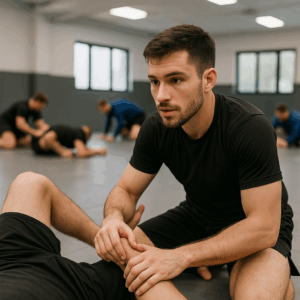


Looking for BJJ Near Me? Here’s How to Choose the Right School
If you’ve been searching Google for “BJJ near me” or “Brazilian Jiu-Jitsu near me,” you’ve probably discovered that you have several options.
So how do you choose the right BJJ school?
Look for experienced instruction, beginner-friendly classes, a positive training environment, structured learning, convenient classes, and a school where you can picture yourself training consistently.
Brazilian Jiu-Jitsu isn’t something you learn in a weekend. Finding the right environment can make a huge difference in whether you enjoy training and stick with it.
At Absolute Martial Arts, we’ve been serving the St. Louis community since 1999, helping beginners and experienced martial artists develop their skills in a positive training environment.
If you’re considering trying BJJ, here are some of the most important things to look for.
What Is Brazilian Jiu-Jitsu?
Brazilian Jiu-Jitsu, commonly called BJJ, is a grappling-based martial art that focuses on controlling an opponent through positioning, leverage, escapes, and submission techniques.
Unlike martial arts that primarily focus on punching and kicking, much of BJJ training takes place on the ground.
Students learn skills such as:
- Positional control
- Escapes
- Sweeps
- Pins and control positions
- Submission techniques
- Defensive strategies
One of the things that makes BJJ so interesting is the emphasis on leverage and technique rather than relying entirely on strength.
It’s physical, technical, challenging, and a lot like solving a puzzle while another person is trying to solve one at the same time.
1. Look for Beginner-Friendly BJJ Classes
If you’ve never trained before, walking into a Brazilian Jiu-Jitsu school can feel intimidating.
That’s normal.
You may see experienced students moving quickly through techniques while you’re still trying to figure out where your hands and feet are supposed to go.
A good BJJ school understands this.
Beginners should be given time to learn fundamental positions, movements, terminology, and techniques.
You shouldn’t be expected to know anything before your first class.
That’s why you’re there.
When searching for BJJ classes near you, ask how the school introduces new students to Brazilian Jiu-Jitsu.
2. Pay Attention to the Instructors
Good instruction matters.
Brazilian Jiu-Jitsu can be highly technical, and having an instructor who can break complicated movements into understandable steps makes learning much easier.
A quality instructor should do more than demonstrate a technique and expect everyone to figure it out.
Look for instructors who:
- Explain techniques clearly
- Emphasize proper mechanics
- Pay attention to safety
- Help beginners without making them feel uncomfortable
- Encourage questions
- Create a respectful training environment
The best instructors understand that different students learn at different speeds.
3. Look at the Training Environment
When visiting a BJJ school, pay attention to the atmosphere.
Do students seem welcoming?
Are beginners treated respectfully?
Are experienced students willing to work with newer students?
Does the class feel organized?
A good martial arts school should challenge you without making you feel like you have something to prove every time you walk through the door.
You’re there to learn.
Your training partners should be there for the same reason.
4. Cleanliness Matters in a BJJ School
This one might not sound exciting, but it’s important.
BJJ involves close-contact training on mats, so cleanliness should be taken seriously.
When visiting a school, look at the facility and training area.
A professional martial arts school should have procedures for keeping the mats and training environment clean.
You’re probably going to spend a lot of time on those mats.
You want them taken care of.
5. Find a BJJ Schedule You Can Actually Attend
The “best” BJJ school doesn’t do you much good if you can never make it to class.
Consistency is one of the biggest factors in improving at Brazilian Jiu-Jitsu.
Before choosing a school, look at the class schedule and compare it with your normal week.
Ask yourself:
Can I realistically train here two or three times per week?
You don’t need to rearrange your entire life around BJJ.
You need a training schedule you can maintain.
6. Look for Structured Learning and Progression
Brazilian Jiu-Jitsu has a huge number of techniques.
If you start watching BJJ videos online, it can quickly feel overwhelming.
There are seemingly endless positions, escapes, submissions, sweeps, and variations.
That’s why structured instruction is valuable.
Beginners need fundamentals.
Over time, those fundamentals become the foundation for more advanced techniques.
Good training isn’t about learning 100 random moves.
It’s about understanding how techniques connect.
7. Choose a School Where You’ll Want to Keep Training
This might be the most important factor of all.
The right BJJ school is one you’ll actually attend.
You can compare websites, schedules, instructors, facilities, and programs all day, but eventually you need to experience a class.
Ask yourself:
Did I enjoy training?
Did I feel comfortable asking questions?
Did the instructor seem interested in helping me improve?
Did the other students make me feel welcome?
Can I picture myself coming back next week?
If the answer is yes, you may have found the right place.
Is Brazilian Jiu-Jitsu Good for Beginners?
Yes. You can start Brazilian Jiu-Jitsu without any previous martial arts experience.
In fact, everyone who trains BJJ was once a beginner trying to understand their first position or technique.
Beginners typically spend time learning foundational concepts such as:
- How to move safely on the ground
- Basic positions
- Positional control
- Escapes
- Defense
- Balance and leverage
- Fundamental submissions
You’re not expected to walk into your first class knowing how to grapple.
You’re there to learn.
Do I Need to Get in Shape Before Starting BJJ?
No.
This is one of the most common reasons people delay starting martial arts.
They tell themselves:
“I’ll start once I get in better shape.”
Then six months pass.
You don’t need to become a runner or spend months lifting weights before trying Brazilian Jiu-Jitsu.
BJJ itself is physically demanding, and your conditioning can develop as you train.
The important thing is starting at an appropriate pace and allowing yourself time to adapt.
Is BJJ a Good Workout?
Brazilian Jiu-Jitsu can be a challenging full-body activity.
Training involves pushing, pulling, gripping, moving your body, maintaining positions, escaping positions, and reacting to another person’s movements.
That can challenge your:
- Cardiovascular endurance
- Muscular endurance
- Core strength
- Grip strength
- Coordination
- Mobility
- Balance
But unlike many traditional workouts, you’re also learning a skill while exercising.
That can make training much more engaging for people who get bored with conventional gym routines.
Is BJJ Good for Self-Defense?
Brazilian Jiu-Jitsu teaches grappling skills that can be relevant to self-defense, particularly understanding control, positioning, escapes, and what to do when a confrontation goes to the ground.
However, responsible self-defense training should always emphasize avoiding unnecessary confrontation whenever possible.
Awareness, de-escalation, creating distance, escaping danger, and getting to safety should remain priorities.
Martial arts training gives you additional tools—not a reason to look for conflict.
What Should I Expect at My First BJJ Class?
Your first Brazilian Jiu-Jitsu class should be about learning—not proving yourself.
Depending on the school and class structure, you may:
- Meet your instructor
- Learn basic BJJ terminology
- Practice fundamental movements
- Learn one or more positions
- Practice a technique with a partner
- Participate in controlled drills
- Observe more experienced students training
Don’t worry about remembering everything.
You probably won’t.
That’s completely normal.
Your first class is simply your introduction.
What Should I Wear to My First BJJ Class?
Contact the school before attending because requirements can vary.
Some Brazilian Jiu-Jitsu classes are practiced in a gi, the traditional uniform used in BJJ.
Other classes are no-gi, where students typically wear athletic clothing designed for grappling.
If you’re attending a New Student Trial, ask the school what you should wear and whether any equipment is provided.
How Often Should Beginners Train BJJ?
For many beginners, training two or three times per week can be a good starting point.
That gives you enough repetition to remember what you’re learning while still giving your body time to recover.
But consistency is more important than trying to train as often as possible.
Training twice a week for a year will generally take you much further than training every day for two weeks and then quitting.
BJJ Near Me: Why Location Matters
When you’re comparing Brazilian Jiu-Jitsu schools near you, convenience deserves more consideration than people sometimes give it.
Imagine two schools.
One requires a long drive through traffic.
The other provides quality instruction and fits naturally into your normal routine.
Which one are you more likely to attend consistently six months from now?
Convenience isn’t everything, but consistency matters tremendously in martial arts.
Finding quality BJJ training in your area can make it much easier to turn martial arts into part of your regular routine.
Why Choose Absolute Martial Arts for BJJ in St. Louis?
Absolute Martial Arts has been serving the St. Louis community since 1999.
Our goal is to provide students with quality martial arts instruction in an environment where they can learn, challenge themselves, and continue improving.
Whether you’re completely new to Brazilian Jiu-Jitsu or already have martial arts experience, training is about progress.
You don’t need to know what you’re doing before you arrive.
You don’t need to already be in great shape.
And you don’t need to prove yourself.
You just need to be willing to learn.
Frequently Asked Questions About Brazilian Jiu-Jitsu
What does BJJ stand for?
BJJ stands for Brazilian Jiu-Jitsu, a grappling-based martial art focused on positioning, control, leverage, escapes, and submissions.
Can a complete beginner start BJJ?
Yes. Beginners can start Brazilian Jiu-Jitsu without previous martial arts or grappling experience.
Am I too old to start Brazilian Jiu-Jitsu?
Adults begin BJJ at many different ages. Appropriate training intensity will depend on your individual fitness, experience, and circumstances.
Will I have to compete?
No. Many people train Brazilian Jiu-Jitsu without ever entering a competition. Students can train for fitness, recreation, self-defense, personal development, or competition depending on their goals.
Will I have to spar during my first BJJ class?
That depends on the school and class structure. New students should be introduced to training appropriately based on their experience and readiness. Ask your instructor what to expect before your first class.
How many times per week should I train BJJ?
Many beginners find that two or three classes per week provides a manageable starting point. Your ideal schedule will depend on your goals, recovery, and availability.
How do I find BJJ classes near me?
When searching for BJJ classes near you, compare instructor quality, beginner programs, school culture, cleanliness, schedule, location, and class structure. Most importantly, experience a class before deciding where you want to train.
Looking for BJJ Classes in St. Louis?
If you’ve been searching for “BJJ near me,” “Brazilian Jiu-Jitsu near me,” or “BJJ classes in St. Louis,” eventually you have to stop searching and step onto the mat.
That’s the only way to find out whether BJJ is for you.
At Absolute Martial Arts, we’ve been serving the St. Louis community since 1999, and beginners are welcome.
🥋 Ask About Our New Student Trial
Come meet our instructors, experience the training environment, and discover Brazilian Jiu-Jitsu for yourself.
Contact Absolute Martial Arts today to get started with your New Student Trial.
Quick Answer: How Do I Choose a BJJ School Near Me?
When choosing a Brazilian Jiu-Jitsu school near you, look for experienced instructors, beginner-friendly classes, a clean facility, structured training, a positive school culture, a convenient schedule, and an environment where you’ll want to train consistently. If you’re looking for BJJ classes in St. Louis, Absolute Martial Arts has been serving the community since 1999 and offers a New Student Trial for people interested in getting started.